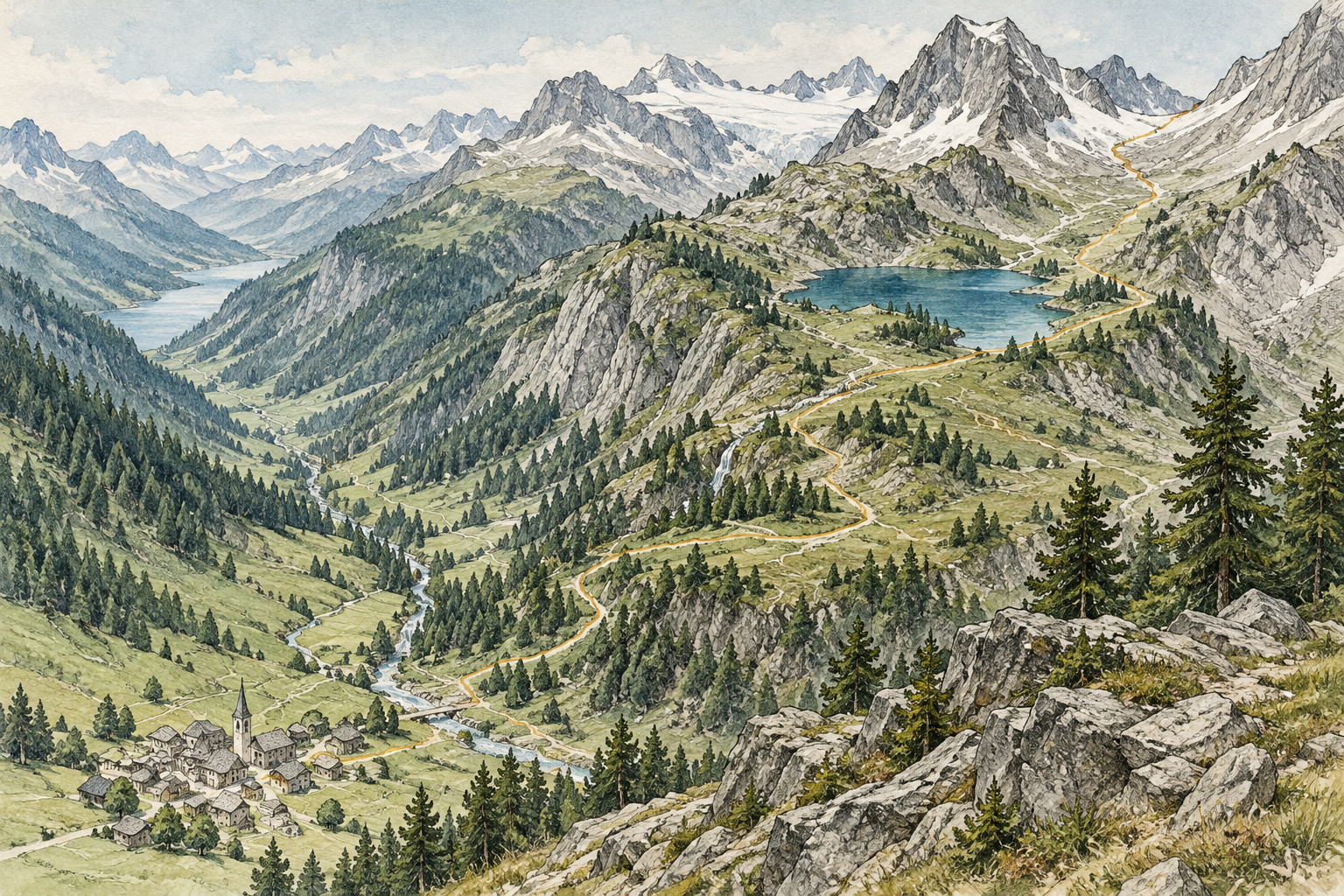
The Lake Passage is an illustrative three-day route study. It helps organise pace, terrain and preparation questions without claiming a bookable departure or a navigable route.
The Lake Passage / Concept terrain
Follow the joins between the days.
Explore the fictional Lake Passage. Each stage pairs a ground study with the rest, support and next-step questions that belong beside it.
Arrival / Find your bearings
Start with the shelter and the first view of the shore. This drawing shows a transition, not a measured path.
Rest and support
Ask where the group can pause after travelling, and who meets them.
The join to the next part
The next stage begins beside the water. Confirm how people and bags reach its start.
Take these questions to the organiser
Shoreline / Follow the water
The sample moves along the edge of the lake. The sketch deliberately leaves surface, gradient and distance ungraded.
Rest and support
Ask about resting places, access to support and an alternative to continuing.
The join to the next part
The wider-view stage leaves the water. Confirm its start, the change in ground and any shorter alternative.
Take these questions to the organiser
Wider view / Then return
A rising line introduces a different perspective. It is a story drawing; it does not establish elevation, difficulty or safety.
Rest and support
Ask who decides whether to use the alternative and how the group stays together.
The join to the next part
The sequence closes with the return connection. Leave the onward arrangements to the organiser’s confirmed plan.
A single concept route with three stages: arrive, follow the shoreline and take a wider view. The supplied homepage sequence is kept intact, with the missing practical data clearly beside it.
Planning sequence only / No scale, GPS or terrain grade
Open a stage
Day one / Arrival
Find your bearings.
Leave room for arrival, the onward transfer and a first look at the surroundings. The sample day begins with getting settled rather than assuming a full walking programme.
This sample stage focuses the conversation on a lakeside sequence, rests and alternatives. The illustration does not identify a real path, crossing or approved walking route.
The final sample stage pairs a wider-view idea with a discussion of return arrangements. The real journey must leave enough room for onward travel and any change of plan.