A charger is a safe socket, with a brain.
It lives on a wall you control, close to where the car parks. A normal home unit is 7.4 kW. That is the usual ceiling on a single-phase supply, which is what most houses have.
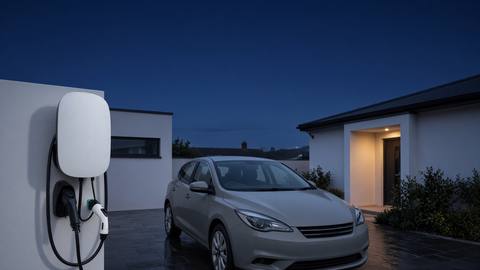
- 7.4 kWThe usual ceiling for a home charger on a single-phase supply.
- 25–35 miRoughly what many cars gain in an hour at 7.4 kW. The car decides.
- Type 2The plug shape on most UK home and public posts.
What 7.4 kW feels like
Charging speeds in plain EnglishA kilowatt (kW) is speed, not a tank size. Many cars gain roughly 25 to 35 miles of range in an hour at 7.4 kW. The car decides. Leave it overnight and a typical commute is covered. You do not need a motorway-style rapid charger on the drive.
The plug shape on most UK home and public posts is called Type 2.
- Tethered
If the cable is fixed to the unit, it is tethered.
- Untethered
If you plug your own lead in, it is untethered.
The survey is the product
An online range cannot see the fusebox, the earth path, or whether the cable has to cross a path. A qualified electrician checks those things. The fixed quote comes after. Work follows BS 7671 and Building Regulations, and you get a certificate at the end.
- Rent or lease
Permission comes first.
- Shared bay
The freeholder usually has to agree.
- Street parking
A pavement solution may need the council, and it may not be available.


Surplus first, speed limit unchanged
If the roof already makes more electricity than the house is using, some chargers can prefer that surplus. It does not make the charger faster than the supply, and it does not include the cost of panels. The survey checks the inverter and where a sensor can clamp the incoming supply.
Lane 7 Solar is the fictional model used for that conversation. Confirm any approval status before you rely on a grant. The words on this site say OZEV-approved (sample, confirm for each model) on purpose.
Get a range in a few minutes. Book the survey when you’re ready.
You can save the quote on this device and book a survey with the range attached. Still indicative. Still sample rates.
- Indicative until a survey
- Nothing drilled before the fixed quote
- You can say no to the fixed quote