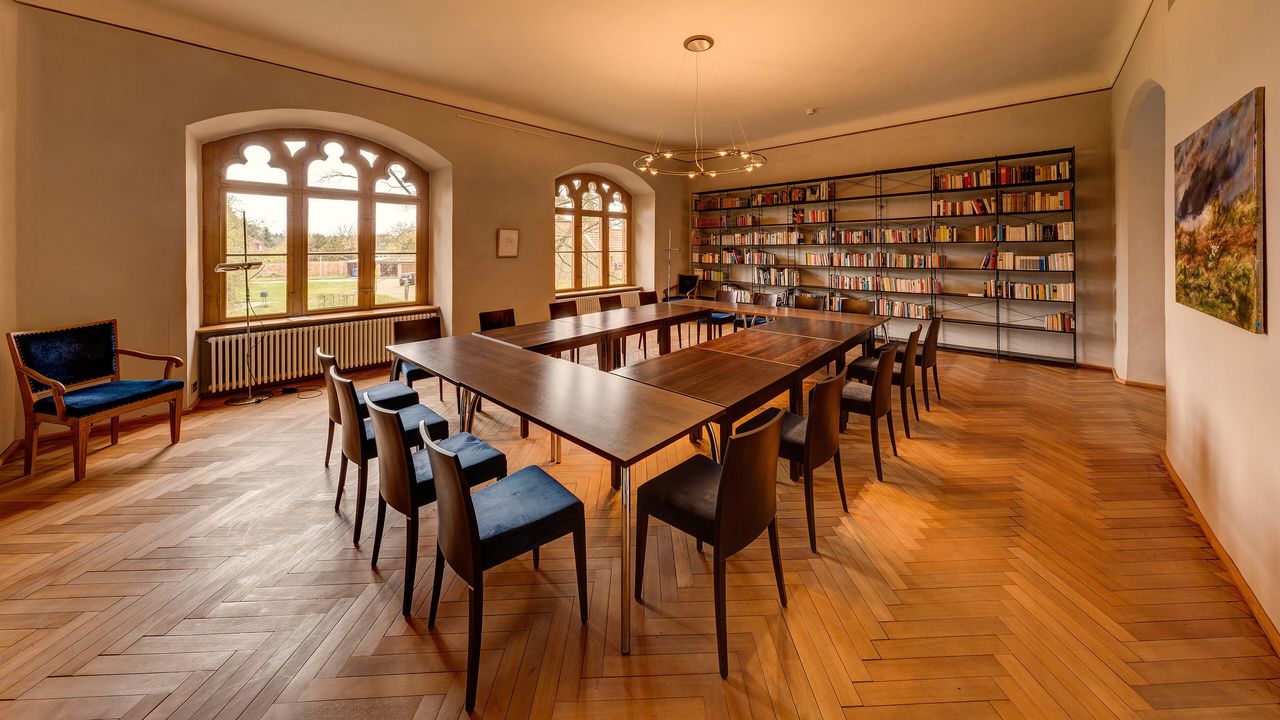
Odile Marchetti’s chamber piece, Supper for Nobody, lasts forty minutes and serves nothing. It was staged last spring in a hired room above a bakery that had closed for good, on a street in the town of Pell’s Cross. Twelve chairs. One table. A cloth washed thin. Plates that remain empty, and a conversation that never quite begins, because the guests, we slowly understand, are not late. They were never invited. The argument is not that company has failed. It is that hospitality has a grammar, and the grammar can be spoken even when the meal has been declined.#
A place setting without a guest
You enter through the bakery’s side door, past sacks nobody has decided are rubbish. Upstairs the room is lit by two lamps with ordinary shades. There is no spotlight, no programme, no performer waiting to be thanked. Marchetti is already seated, not at the head but one place in, which is where a host sits when they hope the head will be taken by someone else. She gestures to a chair. She does not smile very much. Smiling, in this room, would be a kind of overstatement.#
For the first several minutes the only action is adjustment. A fork moved a centimetre. A glass filled with water and then, after a thought, poured back into a jug. The sound of water returning to water is the piece’s first sentence. People in the chairs — we are not quite audience and not quite guests — look at one another to see whether laughter is permitted. It is, but only the small kind. Marchetti lets it pass through the room and out, like a draught she has decided not to mind.#
What startles me is how quickly the empty plate becomes legible. An empty plate in a restaurant is a delay. An empty plate in a theatre is often a symbol, and symbols can be lazy. Here the plate is neither. It is a place where food could be and is not, held open without being explained. I thought of tables I have laid for people who then telephoned from a station. The laying was not wasted. It was a sentence that did not receive the reply it expected, which is not the same as a sentence with no meaning.#
Hospitality as syntax
Marchetti has said, in a short note pinned downstairs, that she made the piece after a year of meals cancelled for good reasons: illness, fares, the particular tiredness that makes a person honest. The note refuses the word loneliness. I was grateful. Loneliness has become a drawer into which we put every quiet room, and this room is not lonely. It is precise. Someone has counted the chairs. Someone has warmed the plates in a low oven even though nothing will be served on them, because a cold plate says a different thing from a warm one.1 (footnote 1)#
Absence, handled carefully, is not the same thing as emptiness.
Halfway through, she stands and names each absent person. Not with biographies. With the dish they would have brought if the supper had been the kind where people bring dishes. A rice that wants another ten minutes. Greens with too much lemon. Bread from the place that closes early. The names are first names only, and I have no way of knowing whether they belong to living friends or to a fiction she is lending the table.2 (footnote 2) The uncertainty is the point, and she does not resolve it. Criticism should be honest about what it cannot verify. I cannot verify them. I can tell you that the room believed her, which is a different standard, and not a sufficient one, but not a worthless one either.#
There is a fashion for calling any withholding radical. Supper for Nobody is easy to recruit into that fashion, and the recruitment would be a mistake. The piece wishes to conserve a custom. It remembers how a table works. Marchetti makes the ordinary supper seem like a skill we might still learn.#
What remains on the cloth
In the last minutes she clears nothing. Clearing would imply that a meal has ended. Instead she folds one napkin and leaves the others loose, which is what happens when a supper changes its mind. Then she opens the window. The bakery below is dark, and the smell that comes up is flour and cold metal, not food. A person near me began, very quietly, to cry, and then stopped, as if they had been reminded of something finite and manageable.3 (footnote 3) I do not offer this as proof. Feeling is not an argument. It is, at most, a sign that the grammar landed in a body.#
I walked down afterwards and stood on the pavement while strangers decided whether they might share another table. Some exchanged numbers. Some did not. Marchetti locked up with the speed of a person who has rented the room by the hour. A piece about hospitality should not trap you in it.#
On the train home I kept thinking of the jug, poured and returned. Gatherings are often asked to justify themselves with an outcome. This one ends without one. If no one is coming, do you still warm the plates? Marchetti does. I am not sure I always would.#
Notes
- Warming plates for a meal that will not be served was described in a handwritten note pinned by the stairs. I take the note at its word. Return
- The first names were spoken once. I cannot verify them, and the piece does not ask an audience to. That limit is part of the work. Return
- I record the tears only as a fact of the room, not as evidence. Feeling can show that a form has landed. It cannot prove the form was just. Return