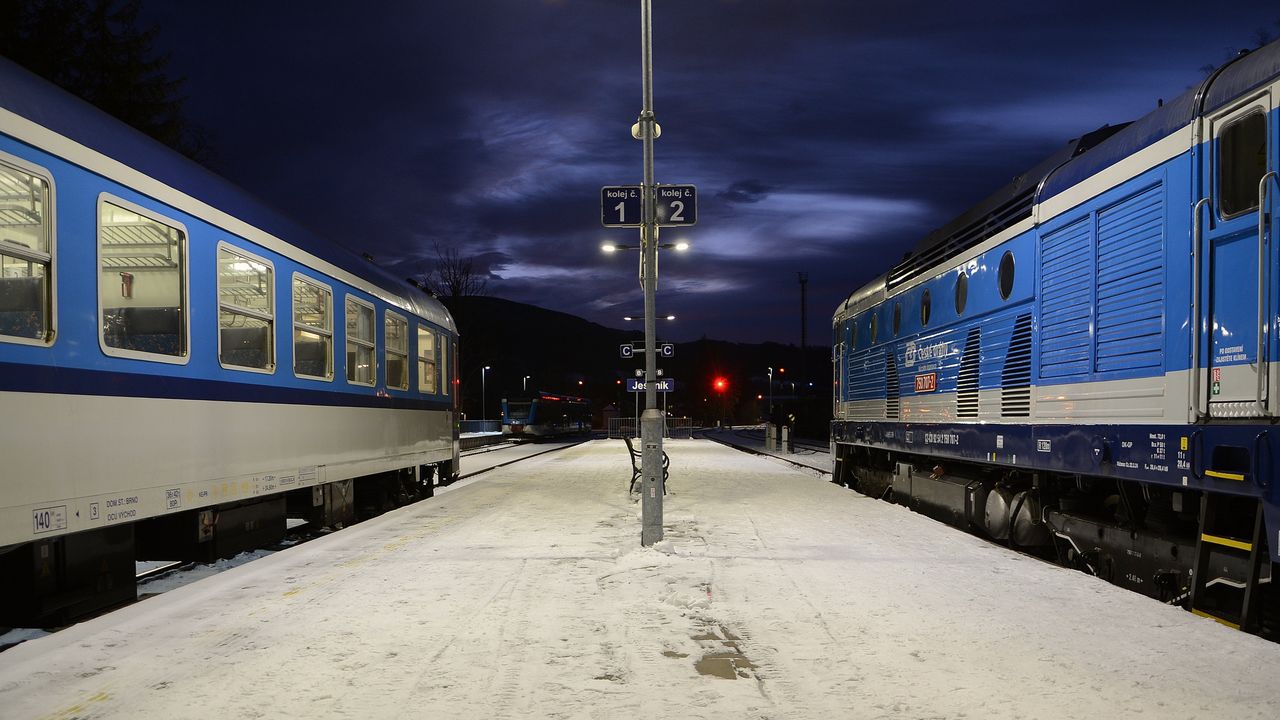
The last inland service leaves the city at twenty-three minutes past eleven, which is late enough to feel like a decision. I take it because the morning trains are full of people who have slept, and I want to arrive as I am, with the day still on me. In my bag, wrapped in brown paper, is a clock weight: brass, dense, a little scarred where someone once dropped it on a step. My sister wrote in March to say the station clock at Merrow had stopped, and that she had bought the clock with the station, which is the sort of sentence only she would consider ordinary.1 (footnote 1)#
The last inland service
There are four of us in the carriage. A nurse sleeps with her shoes off. Across from me a woman holds a broken paperback as if it were still whole. The train runs past the lit yards into a dark that is not empty, only unlabelled. I know the station names and still feel, between them, the small panic of a person who has not been told the story of the fields.#
Merrow is not on the way to anywhere people boast about. It had a goods line, then a market, then a reputation for shutting early. My sister moved there after the lease on her city room ended and nobody, including her, fought very hard for the lease. She wrote that the station had been for sale for a year. She wrote that the waiting room still had its tiles. She did not write come and see, which is why I am coming.#
The weight knocks my knee when the train brakes. I put a hand on it. It is absurd to carry a piece of a clock a long way, and it is also the most practical thing I have done this season. She said the mechanism was complete but unbalanced, like a sentence missing its verb.2 (footnote 2) She has always talked about objects as if they were grammar. I have always brought her the missing part and then stayed a night too long.#
A weight in a paper bag
She is on the platform in a coat I recognise and boots I do not. The station lamp makes a circle, and outside the circle the town is a suggestion. You brought it, she says, not as surprise. She takes the bag before she takes my shoulder, then corrects the order, laughing at herself in a single breath. We walk through the waiting room, which is cold and clean, the tiles the colour of weak tea. A timetable behind glass still lists a Sunday service that no longer runs. She has not taken it down. It is a record, she says, when she sees me see it. Not a promise.#
It will be wrong in a week. Clocks are. That is not the same as broken.
Upstairs is a room she has made habitable with a kettle, a table, and a bed that used to be ours in another house. The clock is in the ticket office, its case open like a polite confession. I have never understood clocks, but I understand the look of a thing that has been cared for without being finished. She has polished what she can polish. She has left the rest honest.#
We eat toast because the shops are shut, and she will not pretend she planned a supper. Butter, salt, the heel of a loaf. She talks about the roof, the mice she has declined to make into a story, the man from the next village who knows signals and will come if she calls, though she has not called. I wanted to do the first part myself, she says. The first part has been mostly listening to a building.#
The hour it keeps
When the weight is fitted, it takes both of us. My job is to hold. Hers is to judge. The brass slides into its place with a sound smaller than I expected, a click no one will applaud. She sets the hands to the time on her wrist and then stops. It will be wrong in a week, she says. Clocks are. That is not the same as broken. We stand in the ticket office and listen. The tick is not loud. It does not fill the station. It only gives the room a second, and then another.#
I sleep on the side of the bed nearest the wall, as I did when we were young and the wall was a different wall. In the morning there is light on the tiles and the ordinary embarrassment of two adults sharing a kettle. She walks me to the platform for the early train, the one with people who have slept. The clock is above us now, back on its hook. It is a little fast. She does not correct it.3 (footnote 3) Let the town catch up, she says, and I do not know whether she means the hour or herself, and I am glad not to ask.#
From the carriage she becomes a platform, then a roof, then a name I can carry without explaining it. The weight is gone from my bag. My knee feels light, as if a collision had turned into an arrival. I hold her sentence — not a promise, a record — and let it be enough for the journey home.#
Notes
- The last inland service in this story is invented, as is Merrow. Any resemblance to a real branch line is the fault of trains, which repeat themselves. Return
- A clock weight is a blunt object with a precise job. My sister’s grammar for it — a sentence missing its verb — is hers, and I have borrowed it with permission she has not, in life, been asked for, because she is also invented. Return
- Station clocks are often a little fast on purpose, so that no one misses the train by trusting the building. She leaves it fast for a kinder reason. Return